sexta-feira, 27 de novembro de 2009

sexta-feira, 14 de agosto de 2009
Nunca a Humanidade viu tão longe!
A Humanidade nunca viu tão longe, e estas são porventura as imagens mais importantes da História.
segunda-feira, 24 de novembro de 2008
Espectacular! Camera de carro da polícia canadiana filma queda de meteoro!
Astrónomos estão neste momento a tentar encontrar restos do meteoro.
quarta-feira, 11 de junho de 2008
terça-feira, 29 de janeiro de 2008
Próximo eclipse total da Lua será em 21 de Fevereiro

Aqui ficam os diagramas do eclipse, que deverá começar por volta da 1 hora da manhã, hora de Lisboa. Clique nas imagens para aumentar. Infelizmente começa muito tarde, e é no meio da semana, pelo que será difícil a quem trabalha assistir a este espetáculo. Já no Brasil as horas serão mais simpáticas. O eclipse total é relativamente breve, cerca de 25 minutos. Todas as fotos e vídeos serão benvindos!
 Links:
 sábado, 26 de janeiro de 2008
quarta-feira, 9 de janeiro de 2008
quinta-feira, 15 de novembro de 2007
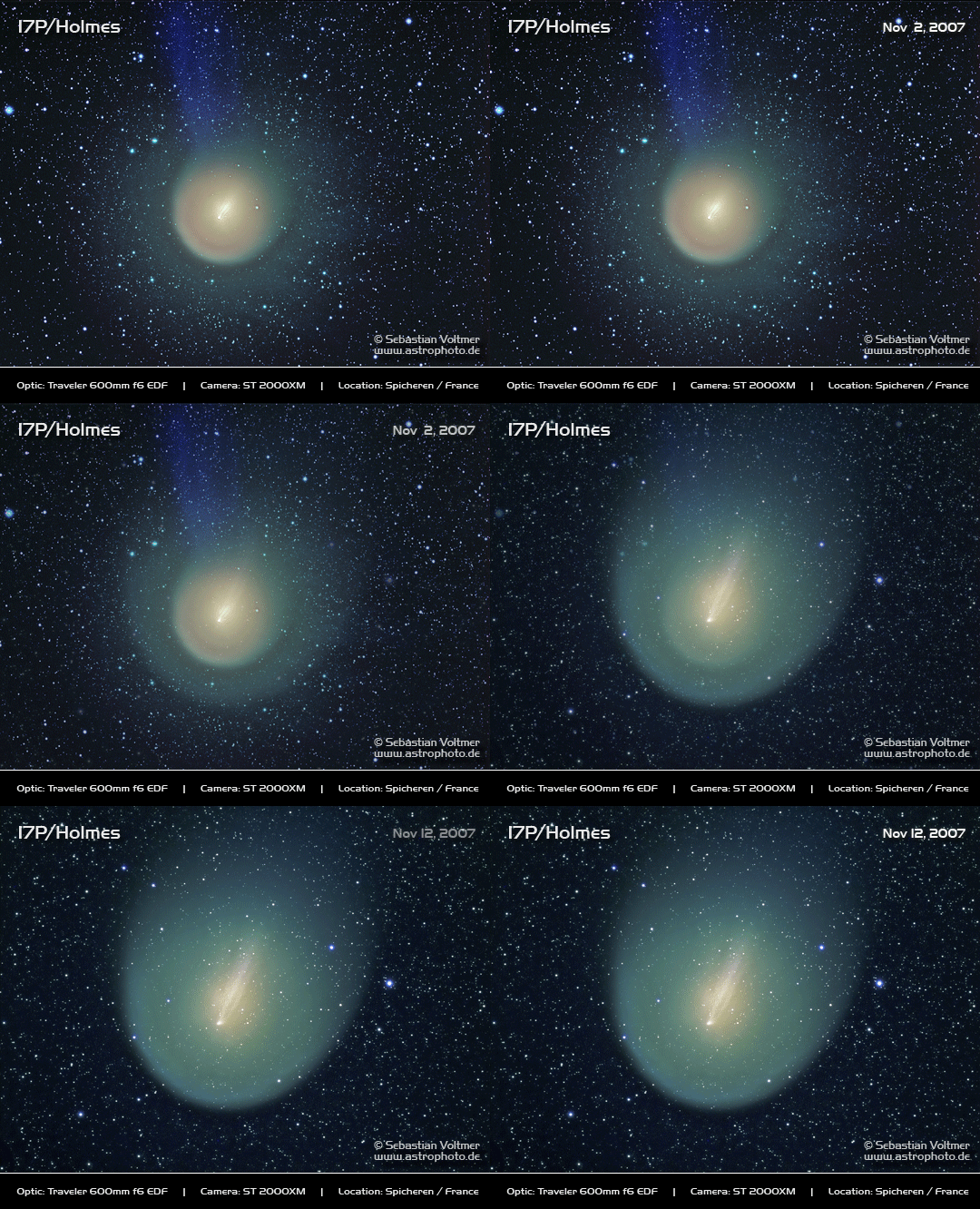
O Cometa Holmes é agora maior do que o Sol!
 Imagem à escala.
Tem agora um diâmetro de 1.4 milhões de quilómetros, sendo assim o maior objecto do Sistema Solar! É visível a olho nú.
Fonte: David Jewitt
Spectacular outbursting comet 17P/Holmes exploded in size and brightness on October 24. It continues to expand and is now the largest single object in the Solar system, being bigger than the Sun (see Figure).
The diameter of the tenuous dust atmosphere of the comet was measured at 1.4 million kilometers (0.9 million miles) on 2007 November 9 by Rachel Stevenson, Jan Kleyna and Pedro Lacerda of the University of Hawaii Institute for Astronomy. They used observations from a wide-field camera on the Canada-France-Hawaii Telescope (CFHT), one of the few professional instruments still capable of capturing the whole comet in one image.
Other astronomers involved in the UH program to study the comet include Bin Yang, Nuno Peixinho and David Jewitt. The present eruption of comet Holmes was first reported on October 24 and has continued at a steady 0.5 km/sec (1100 mph) ever since.
The comet is an unprecedented half a million times brighter than before the eruption began. This amazing eruption of the comet is produced by dust ejected from a tiny solid nucleus made of ice and rock, only 3.6 km (roughly 2.2 miles) in diameter.
The new image also shows the growth of a tail on comet Holmes (the fuzzy region to the lower right in the comet picture), caused by the pressure of sunlight acting on dust grains in the coma. Over the next few weeks and months, the coma and tail are expected to expand even more while the comet will fade as the dust disperses.
Comet Holmes showed a double outburst in November 1892 and January 1893. It is not known if the present activity in the comet will follow the pattern from 1892, but continued observations from Mauna Kea are planned to watch for a second outburst. Most comets show small fluctuations in brightness and some have distinct outbursts.
The huge event on-going in comet Holmes is unprecedented, however. The orbit period of comet Holmes is about 6 years, putting it in the class of Jupiter Family Comets whose orbits are strongly influenced by Jupiter. These objects are thought to have spent most of the last 4.5 billion years orbiting the Sun beyond Neptune, in a region known as the Kuiper Belt. Holmes probably was deflected into its present orbit within the last few thousand years and is losing mass as it evaporates in the heat of the Sun. In another few thousand years it is likely either to hit the Sun or a planet, be ejected from the Solar system, or simply die by running out of gas.
Contacts Rachel Stevenson [rach@ifa.hawaii.edu 808-956-6680] David Jewitt [jewitt@ifa.hawaii.edu 808-956-7682]
David Jewitt. Last updated 09 Nov 2007
terça-feira, 6 de novembro de 2007
Cometa 'explosivo' visível a olho nú.
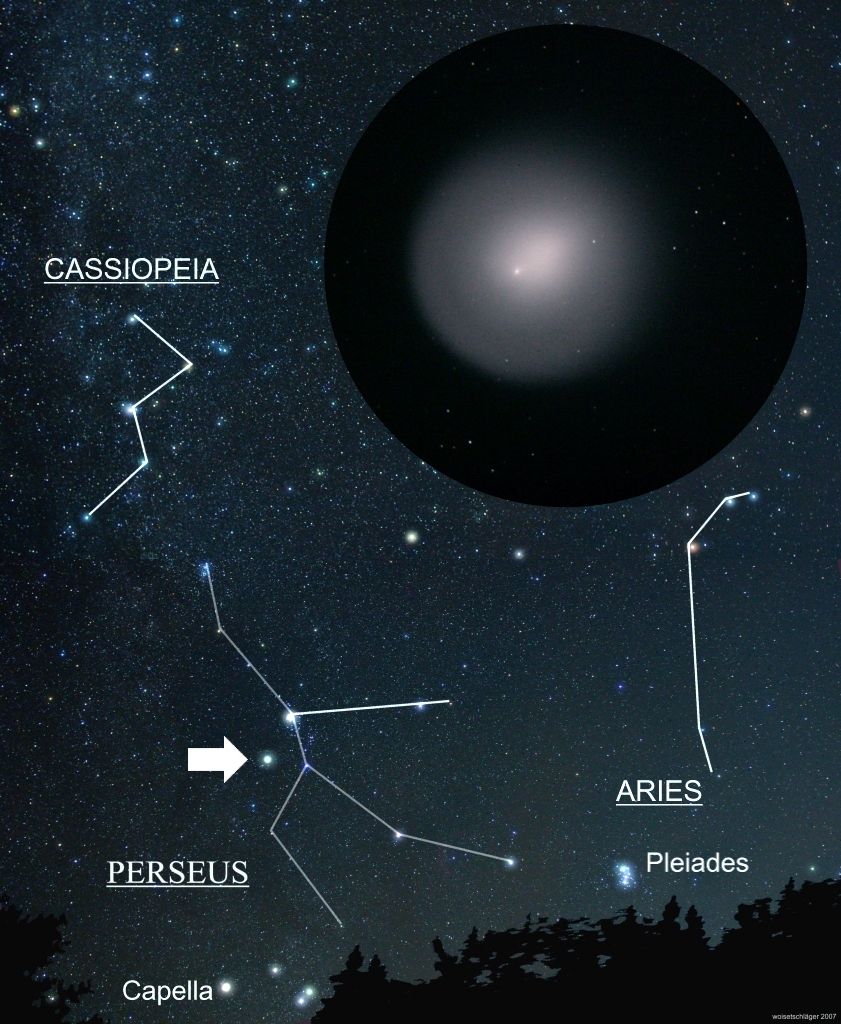
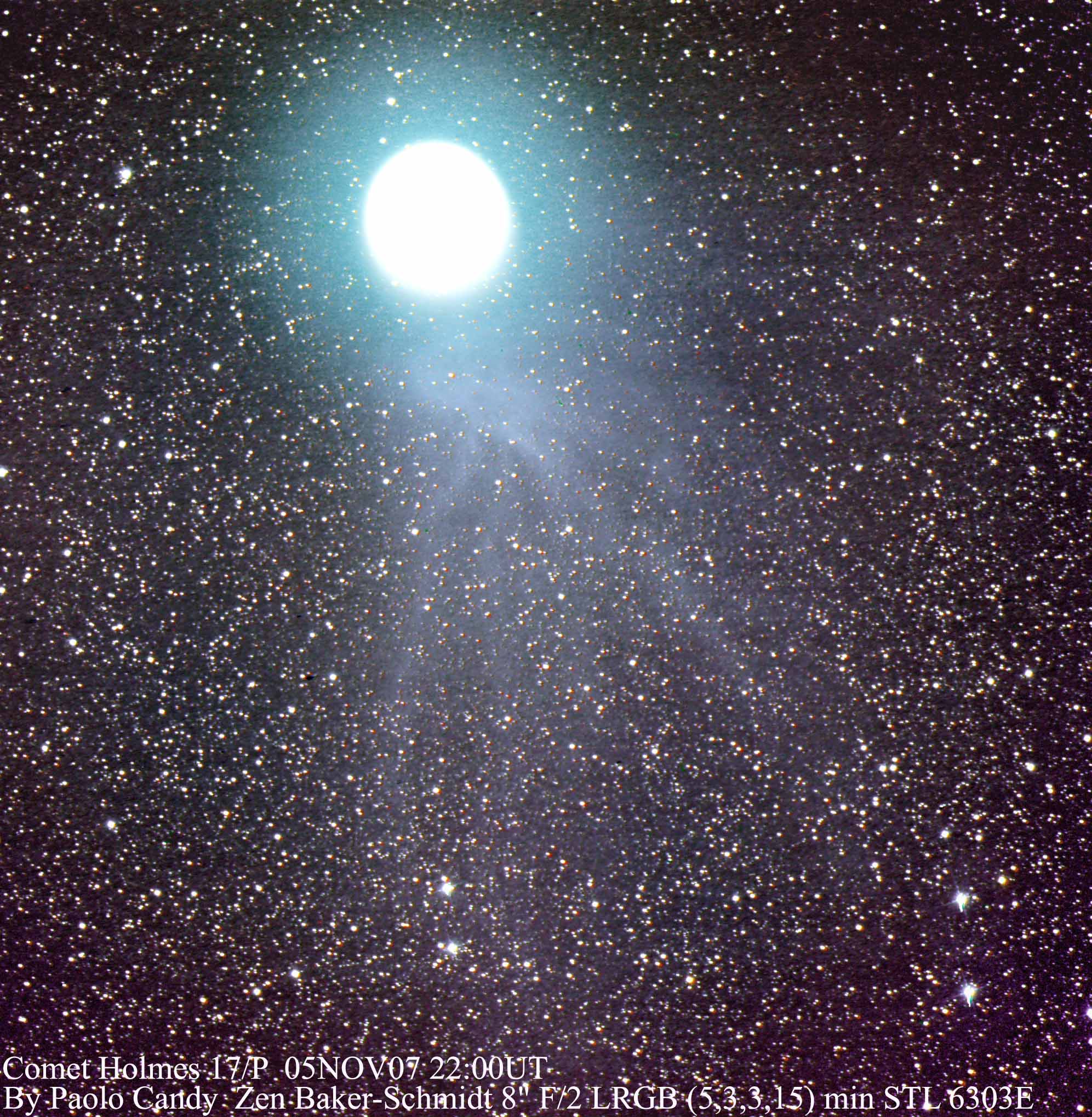 Trata-se de um cometa que explodiu recentemente, tornando-se maior do que o planeta Júpiter (o maior do nosso sistema solar!). Agora é visível a olho nú, após o pôr do Sol, no hemisfério Norte. Aqui fica o mapa para auxiliar a localização:
 Clique para aumentar.
 Clique para aumentar.
KNOXVILLE, Tenn. - A comet that has unexpectedly brightened in the past couple of weeks and now is visible to the naked eye is attracting professional and amateur interest.
Paul Lewis, director of astronomy outreach at the University of Tennessee, is drawing students to the roof of Nielsen Physics Building for special viewings of Comet 17P/Holmes.
The comet is exploding and its coma, a cloud of gas and dust illuminated by the sun, has grown to be bigger than the planet Jupiter.
The comet lacks the tail usually associated with such celestial bodies but can be seen in the northern sky, in the constellation Perseus, as a fuzzy spot of light about as bright as the stars in the Big Dipper.
"This is truly a celestial surprise," Lewis said. "Absolutely amazing."
Until Oct. 23, the comet had been visible to modern astronomers only with a telescope, but that night it suddenly erupted and expanded.
A similar burst in 1892 led to the comet's discovery by Edwin Holmes.
"This is a once-in-a-lifetime event to witness, along the lines of when Comet Shoemaker-Levy 9 smashed into Jupiter back in 1994," Lewis said.
Scientists speculate the comet has exploded because there are sinkholes in its nucleus, giving it a honeycomblike structure. The collapse exposed comet ice to the sun, which transformed the ice into gas.
"What comets do when they are near the sun is very unpredictable," Lewis said. "We expect to see a coma cloud and a tail, but this is more like an explosion, and we are seeing the bubble of gas and dust as it expands away from the center of the blast."
Experts aren't sure how long the comet's show will last, but estimate it could be weeks — if not months. Using a telescope or binoculars help bring the comet's details into view, they said.
Skywatchers marvel at surprise comet
Cosmic fuzzball should be visible to naked eye for next few weeks
Skywatchers throughout the Northern Hemisphere report the newly visible Comet Holmes is a remarkable sight even under city lights. The comet, described in glowing terms by many observers, should continue to be visible to the naked eye for at least the next few weeks.
Only a couple comets each decade are this easy to see.
Holmes is actually an old comet. First seen in November 1892 by British observer Edwin Holmes, it has since made 16 circuits around the sun and should have fizzled out a long time ago. It made its closest approach to the sun last May, yet never came closer to it than 191 million miles (307 million kilometers). The comet is actually moving away from the sun now, almost midway between the orbits of Mars and Jupiter. Not exactly a recipe for an outburst, since solar heating is typically what triggers comets to brighten.
But sometime late last Tuesday, this comet underwent an explosive outburst and within just 24 hours increased its brightness almost a millionfold. Since then, Holmes has been putting on a unique display, looking very different than any other comet of our generation: It has yet to sprout a noticeable tail, while its head — called the coma — appears like a round, yellowish fuzzball in the constellation Perseus, and is visible for most of the night.
Since its outburst, Holmes has shone almost consistently between magnitudes 2 and 3, making it similar in brightness to the stars that make up the famous Big Dipper. (On this astronomer's scale, smaller numbers represent brighter objects.)
Use the ‘W’ as a guide
You can find Comet Holmes by using the "W" of Cassiopeia as your guide. The five stars in a conspicuous zigzag pattern are high in the northeast sky during midevening.
Draw an imaginary line from the star Gamma Cass down to Delta Cass (known also as Ruchbah). Extend the line downward about five times the distance between these two stars and you'll come very close to where Comet Holmes is. The comet itself forms a triangle with Alpha Persei (known also as "Mirfak") and Delta Persei.
If you have binoculars, you'll know the comet immediately when you see it: a small, albeit distinct, circular lemon-yellow cloud of light. A small telescope will help bring out the fuzzy details.
The moon, which was full on Oct. 26 and whose brilliant light hindered comet viewing to a degree, is now diminishing in phase and rising later in the night, allowing viewers an increasing window of dark sky before the moon interferes. The moon is one day before last quarter on Wednesday and rises just after 11 p.m.. But by Nov. 4, after the switch to standard time, it will be rising around 1:20 a.m., having shrunk to a crescent and leaving more than half of the night dark for comet watchers.
Reports from around the world
Bryan Bradley, an amateur observer from Long Island, N.Y., writes: "I went out the past two nights and observed the comet from my driveway observatory. Very interesting how bright it has become. My daughters also saw it with me and commented that it looked like a big fuzzy ball, but where is the tail?"
Percy Mui photographed the comet from Illinois, capturing the fuzzball appearance reported by many.
Another Long Island amateur observer, Rich Tyson, relates that "my wife Antoinette described Comet Holmes as looking like a 'fried egg.' Can we call it the 'Fried Egg Comet'?"
Well-known comet observer John Bortle of Stormville, N.Y., has carefully scrutinized the comet on a number of nights with a variety of different instruments. He saw the comet on Sunday evening without the glaring moon in the sky. "So much info was recorded I can't begin to report more than a fragment of it here. A double envelope feature surrounding the comet is truly spectacular in the darker sky."
Similar raves were coming in from other places around the globe.
Eddie Guscott from Essex, England, had been trying to see Comet Holmes since it exploded into view, but "the weather here has been dire: 100 percent cloud. So it was a great surprise to finally get an hour of clear weather enabling me to observe this wonderful sight. I have never seen anything like it before."
Robert McNaught, discoverer earlier this year of a spectacular daylight comet that bears his name, observed Comet Holmes from Siding Spring, Australia.
"The comet was a surprisingly easy naked-eye object despite the near-full moon sitting above it," McNaught said of Comet Holmes. "Lovely views in the Uppsala's 6-inch finderscope at 80x showing the faint stellar condensation ... within the large 'planetary nebula'-like coma. Very impressive."
Also during the night of Oct. 28, there was a brief flurry of excitement as many observers thought they had seen the comet's nucleus split in two. What actually happened, however, was that the comet passed very near to a faint background star with virtually the same brightness as the inner coma, giving the impression that a splitting had occurred. As of this writing, the entire comet remains intact.
What caused the outburst?
More than a week after Comet Holmes erupted, astronomers are still debating what caused it.
Some think it might be due to a rich vein of volatile ices on the comet's nucleus that was suddenly exposed to sunlight. This is actually the second time that Holmes has flared up in this manner, the last time coming in its discovery year of 1892.
Bortle suggested the nucleus of Comet Holmes might consist of low-density material that, over time and through outgassing, develops a large region with a very tenuous structure, perhaps like a honeycomb.
"Cometary nuclei being irregular in shape, rotation or perhaps even the minute gravity of the nucleus itself will create increasing shear forces if the area is remote from the center of rotation," Bortle said. "At some point, the highly fragile bonds connecting the honeycomb of material will reach the failing point and a collapse, or more likely a sudden crushing/consolidating event on a grand scale perhaps covering several square kilometers wide and deep, will occur. This crushing collapse would expel a truly gigantic volume of dust in the process."
Another outburst possible?
The show could have a reprise later this year.
"Those who are familiar with terrestrial structural collapse situations are aware that the primary event often leaves a large amount of instability in the material involved," Bortle said. "This remaining instability will only remain for a short time before a further adjustment toward stability occurs, resulting in a major second collapse, with an outward physical appearance very similar to that of the initial event."
Back in 1892, Comet Holmes underwent a second outburst about 75 days after the first.
Will there be a "cosmic aftershock" that will again cause the comet's brightness to again spike a similar number of days after the big Oct. 23 outburst this year? Bortle thinks it's a possibility.
"I would urge everyone to watch very carefully for a possible repeat of this secondary event about the turn of the year," he said.
quarta-feira, 17 de outubro de 2007
Anatomia de um Buraco Negro
 Um pequeno e simples site interactivo, que nos mostra as principais características dos buracos negros. Recomendado para os que não conseguem visualizar as descrições por escrito, estranhíssimas, nos livros de Stephen Hawking, por exemplo :)
sexta-feira, 17 de agosto de 2007
Aprenda a identificar as constelações
 Através de uma sequência de imagens que representam o céu nocturno, este site ajuda-o a dar os primeiros passos na identificação das principais constelações, da Estrela Polar, e dos planetas. É bastante simples seguir os passos. São cerca de 80 imagens com graus diferentes de detalhe, em que por vezes nos são dadas indicações, e outras nos são feitas questões a que temos de responder, clicando com o rato na estrela ou constelação em questão. Não se preocupe se não fôr capaz de localizar uma determinada constelação, há sempre a possibilidade de dizer que não se sabe.
Achei a idéia bem realizada, com simplicidade mas eficácia. Assim que puder irei testar os meus conhecimentos, olhando para o céu 'a sério'. Mas já fiquei com umas noções básicas que, de outras formas, nunca tinha captado.
quinta-feira, 2 de agosto de 2007
O sucessor do Telescópio Espacial Hubble
 Clique para aumentar.
Ao contrário do Hubble, o JWST não obterá imagens nos comprimentos de onda visíveis, mas apenas em infra-vermelhos.
Também ao contrário do Hubble, não será lançado do Space Shuttle - que em 2013 já deverá estar desactivado - mas da ogiva de um foguetão - o que lhe permitirá também atingir uma órbita (muito) mais elevada.
Teóricamente será capaz de obter imagens de quando o Universo apenas tinha 400 milhões de anos de idade - o que corresponde à sua infância muito precoce, em termos humanos! Com sorte obterá imagens dos primeiros objectos luminosos do Universo!
1 - Espelhos
O JWST é equipado com 18 espelhos hexagonais, de berílio, cada um com 1,29 m de diâmetro. O berílio é mais leve, forte e estável que o vidro. O espelho composto deverá ter metade do peso do espelho do Hubble, mas é 2,5 vezes maior. Cada segmento pode ser orientado em 6 direcções diferentes.
2 - Micro-obturadores
O colector de imagem do JWST tem 62.415 aberturas, cada uma com cerca de 100 x 200 microns de dimensão. Estes poderão captar espetrogramas de 100 galáxias de cada vez. Os obturadores poderão ser abertos independentemente, conforme as galáxias que estejam no campo de visão do JWST.
3 - Dispositivos infra-vermelhos
Existem 4 dispositivos de captação de imagem de muito alta resolução instalados no JWST - semelhantes aos chips das máquinas fotográficas digitais normais. Existe uma camera fotográfica sensível ao espectro próximo do infra-vermelho, um espectrógrafo sensível à mesma gama de comprimentos de onda, uma camera sensível ao meio do espectro infravermelho, e um sensor para orientação de precisão.
4 - Pára-SolDestina-se a proteger o JWST da luz e radiação infra-vermelha (calor) do Sol, que invalidaria o trabalho deste telescópio. É composto por 5 camadas de alumínio e silício do tamanho de um court de ténis! São necessárias 5 camadas para proteger o JWST de impactos por micro-meteoritos.
O JWST ficará localizado num ponto do espaço designado L2 - o ponto Lagrange 2 - onde a gravidade da Terra e do Sol têm a mesma força. Este ponto é a cerca de 1.500.000 kms de distância da Terra. Qualquer missão de serviço, à semelhança das que ocorreram para o Hubble, será impossível com as tecnologias actuais. O JWST estará 5 vezes mais distante da Terra do que a Lua! Qualquer avaria não será reparável. (Ver actualização abaixo).
Actualização em 3 de Agosto de 2007: A NASA vai adicionar um anel de acoplagem ao JWST, para permitir uma possível missão futura de serviço pelas naves Orion!!!
Fonte: MSNBC
NASA to add docking ring to Hubble heir
James Webb Space Telescope could accommodate astronauts’ service call
By Brian Berger
Space.com
Updated: 7:28 p.m. ET May 23, 2007
NASA is adding a docking ring to the James Webb Space Telescope (JWST) just in case a visit by astronauts aboard a future Orion Crew Exploration Vehicle is needed to complete deployment of the multibillion-dollar orbiting observatory. The U.S. space agency made the announcement May 10 during the unveiling of a full-scale model of the JWST on the National Mall here.
Billed as the successor to the Hubble Space Telescope, the JWST is slated to launch in mid-2013. By the time it is fully expanded as it is deployed at a gravitationally stable spot some 1.5 million kilometers from Earth, the spacecraft will be about the length of a tennis court. Building, launching and operating the infrared telescope for 10 years is expected to cost $4.5 billion, making it the most expensive science mission NASA has in development.
"We cannot make the James Webb Space Telescope fully serviceable like the Hubble because that would cost so much money that I don't think this country could afford it," said Edward Weiler, director of NASA Goddard Space Flight Center, the Greenbelt, Md., facility in charge of the Webb telescope. "However, what if you have a bad day when you put this thing a million miles out and everything folds out except for an antenna ... it gets stuck? Or a solar panel doesn't fold out completely, and you say, 'gee, I wish we could send an astronaut just to give it a kick'?"
Weiler said NASA Administrator Mike Griffin asked the James Webb team two years ago to examine whether it was worthwhile to design the telescope to accommodate a visit from Orion.
According to Weiler, it is.
"We are going to design for the James Webb Space Telescope a little ring that the Crew Exploration Vehicle could dock with so if we had a bad day the astronauts could go out to James Webb and do minimal, gross things," he said. "They couldn't replace instruments, they couldn't change out things, but they could fix things that were obviously wrong."
Weiler said it is his hope and expectation that an astronaut service call never proves necessary. That point was seconded by Martin Mohan, the JWST program manager at Redondo Beach, Calif.-based Northrop Grumman Space Technology.
"We are spending a great deal of time in testing to make sure that JWST deploys reliably on orbit," Mohan said. "That is one of the core competencies of Northrop Grumman Space Technology. That was, we believe, one of the factors in our selection. That doesn't mean we take it lightly in any stretch of the imagination."
The decision to add a docking ring to the Webb telescope was news to Griffin. Asked about it May 16, he said: "A year or two ago I asked people if it wouldn't be smart to at least have some capability to dock Orion with James Webb such that if people wanted to service it, they could do so. It only seems to me to make sense to not preclude that. I didn't tell them to do it. So if they are doing it, they must have studied it and come to the conclusion that it is a worthwhile thing to do."
Meanwhile, a NASA review board recently determined that all 10 new technologies key to the success of the JWST are mature enough to move into the detailed engineering phase of the program. Among those new technologies are near-infrared detectors, sunshield materials and lightweight cryogenic mirrors.
"The invention is done more than six years ahead of launch," Mohan said. "That's an unprecedented achievement."
Weiler agreed, saying that Hubble's launch was delayed several years because its enabling technologies were not ready, adding hundreds of millions of dollars to the cost of the project.
Mohan said that thanks to the new technologies, Webb's 6.5-meter mirror will weigh only half of what Hubble's mirror weighs yet will provide nine times as much light-collecting power.
The Ball Aerospace-designed mirror, which is already in fabrication, consists of 18 separate segments that will be unfolded during deployment and held in place by composite structures developed by Minneapolis-based Alliant Techsystems.
Weiler said the JWST has met every budget and technical milestone in the 20 months since NASA restructured the project, delaying its launch two years and adding $1 billion to the life-cycle cost estimate. The project's next major review is slated for March 2008.
As expensive as JWST might seem, Weiler said, when all is said and done it will cost roughly half of what NASA has spent on Hubble — about $7 billion to $8 billion adjusted for inflation and measured according to the same accounting methods that govern Webb.
segunda-feira, 30 de julho de 2007

quinta-feira, 12 de julho de 2007
Contribua para a Exploração do Espaço através da Internet
 Através deste site, no qual se pode registar sem qualquer dificuldade, poderá ajudar os astrónomos através de uma tarefa bastante simples, que é identificar, em várias fotografias, quais são galáxias em espiral e quais são as galáxias elípticas. É-lhe dada uma pequena explicação sobre como identificar umas e outras, e é-lhe feito um curto teste. Se passar o teste pode passar 'ao trabalho' própriamente dito.
 Muitas destas galáxias nunca foram vistas por olhos humanos, por isso de certeza que poderá ver sempre algo que nunca antes foi visto! Só por esta oportunidade já vale a pena. Até pode descobrir galáxias em colisão! Se não conseguir identificar o tipo da galáxia em questão, não se preocupe, pode sempre clicar na opção 'não sei'.
Fonte: Daily Mail
Link: Galaxy Zoo
Scientists ask public to help sort galaxies
Last updated at 17:44pm on 11th July 2007
Astronomers are inviting members of the public to help them make major new discoveries by taking part in a census of one million galaxies.
Visitors to www.galaxyzoo.org will get to see stunning images of galaxies, most of which have never been viewed by human eyes before.
By sorting these images into "spiral galaxies" (like our own Milky Way) or "elliptical galaxies", visitors will help astronomers to understand the structure of the universe.
The new digital images were taken using the robotic Sloan Digital Sky Survey telescope in New Mexico.
"It's not just for fun" said Kevin Schawinski of Astrophysics at Oxford University where the data will be analysed. "The human brain is actually better than a computer at pattern recognition tasks like this. Whether you spend five minutes, fifteen minutes or five hours using the site your contribution will be invaluable."
Visitors will be able to print out posters of the galaxies they have explored and even compete to see who's the best virtual astronomer.
The galaxyzoo.org team were inspired by projects such as Stardust@home, in which NASA invited the public to sort through dust grains obtained by a mission to Comet Wild-2. Oxford's Dr Chris Lintott, co-presenter of the BBC's Sky at Night programme and galaxyzoo.org team member, commented:
"What the Stardust team achieved was incredible, but our galaxies are much more interesting to look at than their dust grains. We hope that participants in Galaxy Zoo will not only contribute to science, but have a lot of fun along the way."
Images for the project are taken from the Sloan Digital Sky Survey, which uses a 142-megapixel digital camera to create the largest digital map of the universe.
"It is great that digital archives we have built for science are now being used by the public to look at the universe," says Professor Bob Nichol from the University of Portsmouth. "It will be great to have all the galaxies classified; it's as fundamental as knowing if a human is male or female."
The astronomers hope that the survey will shed light on how different kinds of galaxies are distributed across the sky. The results might even reveal that there is something fundamentally wrong with existing models of the universe.
Sir Patrick Moore, an enthusiastic supporter of the project, said: "Non-professionals have always been deeply involved in studying the sky and they now have yet another opportunity to make themselves really useful. Moreover, their help is now of immense value so do join up – as I am doing myself!"
terça-feira, 3 de julho de 2007
Comparação entre o tamanho do Sol e o da maior estrela conhecida
 Terá de clicar na imagem para a aumentar. O Sol nem sequer é visível a esta escala - é só um pixel!
 Imaginem agora o tamanho da Terra! E do escritório onde estão a trabalhar. E o da vivenda com piscina e uma quinta que alguns andam a lixar os outros para arranjar dinheiro para comprar...
Não é significativo. Preocupem-se com outras coisas. :)
quarta-feira, 27 de junho de 2007
Imagens da separação do Space Shuttle Atlantis da Estação Espacial Internacional, vistas de Terra!

 Phil Plait, autor do blog Bad Astronomy, tirou estas duas fotos, de exposição longa, que mostram claramente o Shuttle Atlantis a separar-se da ISS. O Atlantis é o rasto mais escuro.
Plait utilisou apenas uma máquina fotográfica comum, montada num tripé, para obter estas fotos, e recorreu ao site Heavens-Above para saber se a ISS iria passar por cima de sua casa.
Link: Bad Astronomy
domingo, 10 de junho de 2007
Um ponto azul-pálido
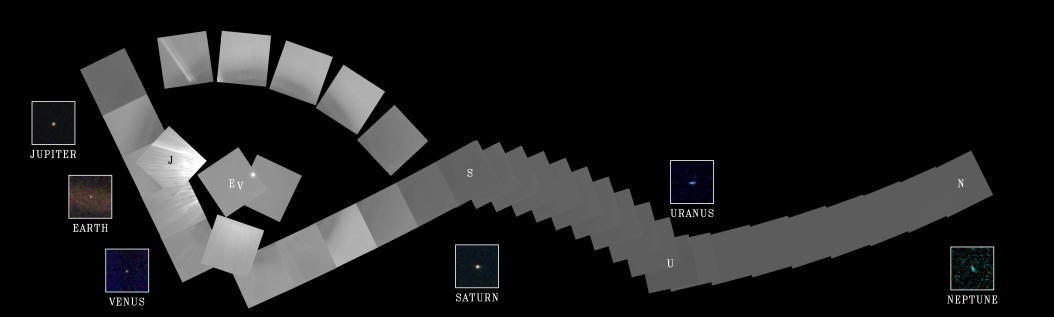
Quando a sonda Voyager 1 saía do Sistema Solar, Carl Sagan conseguiu convencer a NASA a enviar instruções ao seu longínquo emissário, para que tirasse uma série de fotos que apresentassem uma vista panorâmica do nosso Sistema Solar.
O resultado está aqui em baixo:
 Clique para aumentar.
A Terra, o nosso pequeno planeta, não é mais que um ponto azul pálido nesta panorâmica. Pode ser vista nesta foto:
 Com estas imagens, Carl Sagan proferiu este mini-discurso em 11 de Maio de 1996, poucos meses antes da sua morte:
(NOTA: As palavras do vídeo são ligeiramente diferentes das palavras do discurso. Mas não é o detalhe que interessa...)
We succeeded in taking that picture [from deep space], and, if you look at it, you see a dot. That's here. That's home. That's us. On it, everyone you ever heard of, every human being who ever lived, lived out their lives. The aggregate of all our joys and sufferings, thousands of confident religions, ideologies and economic doctrines, every hunter and forager, every hero and coward, every creator and destroyer of civilizations, every king and peasant, every young couple in love, every hopeful child, every mother and father, every inventor and explorer, every teacher of morals, every corrupt politician, every superstar, every supreme leader, every saint and sinner in the history of our species, lived there on a mote of dust, suspended in a sunbeam.
The earth is a very small stage in a vast cosmic arena. Think of the rivers of blood spilled by all those generals and emperors so that in glory and in triumph they could become the momentary masters of a fraction of a dot. Think of the endless cruelties visited by the inhabitants of one corner of the dot on scarcely distinguishable inhabitants of some other corner of the dot. How frequent their misunderstandings, how eager they are to kill one another, how fervent their hatreds. Our posturings, our imagined self-importance, the delusion that we have some privileged position in the universe, are challenged by this point of pale light.
Our planet is a lonely speck in the great enveloping cosmic dark. In our obscurity -- in all this vastness -- there is no hint that help will come from elsewhere to save us from ourselves. It is up to us. It's been said that astronomy is a humbling, and I might add, a character-building experience. To my mind, there is perhaps no better demonstration of the folly of human conceits than this distant image of our tiny world. To me, it underscores our responsibility to deal more kindly and compassionately with one another and to preserve and cherish that pale blue dot, the only home we've ever known.
Palavras essenciais para todos aqueles que acham que a sua vida é muito mais importante que seja o que fôr.
quinta-feira, 10 de maio de 2007
Poluição luminosa
 Muito resumidamente é o que o/a impede de ver o céu à noite desta forma!
Há duas coisas que fazem com que de noite já não vejamos as estrelas, sobretudo se vivermos perto de grandes cidades como Lisboa. A poluição atmosférica, maior nestas zonas, e a iluminação nocturna. As luzes da cidade são reflectidas na atmosfera pela camada de poluição e humidade, fazendo com que o céu fique claro - tão claro que só as estrelas e planetas mais brilhantes se podem ver.
As soluções para este problema, que não afecta só os astrónomos, mas também qualquer pai ou mãe que queira mostrar as estreals aos filhos, passam pelo controlo da poluição atmosférica - que pelo que parece só será possível no médio/longo prazo - e pela adopção de sistemas de iluminação nocturna que não 'desperdicem' luz enviando-a directamente para cima. Uma possível solução será a adopção de reflectores na parte superior dos candeeiros, por exemplo. Claro que isso limitará as opções de design, mas creio que as estrelas são mais bonitas que a vaidade de qualquer designer... E os designers hão de concordar comigo.
Para sensibilizar as pessoas para este problema, que se agrava lenta e gradualmente, e propôr possíveis soluções, foi criada a International Dark-Sky Association, a cujo site sugiro uma visita.
Link: International Dark-Sky Association
quinta-feira, 26 de abril de 2007
Descoberto o primeiro planeta parecido com a Terra
 Não, esta ainda é a nossa...
Na realidade é algo optimista, ainda, dizer que o planeta é parecido com a Terra. É um planeta com uma massa que é 1,5 vezes a da Terra, em órbita de uma estrela gigante vermelha - Gliese 581, na constelação da Balança, a 21 anos-luz da Terra - a uma distância que lhe permite beneficiar de temperaturas parecidas com as da Terra, ou seja, em que pode existir água no estado líquido, logo, vida.
Evidentemente que daí a dizer que o planeta é parecido com a Terra vai uma grande distância. Ainda não se pode analisar a atmosfera do planeta, não se sabe se há água ou oxigénio ou o que quer se seja acerca daquele planeta.
No entanto é uma descoberta histórica, porque é o primeiro planeta que é descoberto com o tipo de condições que lhe permitirão ser um candidato a 'irmão da Terra'.
Fonte: Adelaide Now
Link: Universe Today
New earth find suggests we are not alone
MICHAEL HANLON, LONDON DAILY MAIL, CLARE PEDDIE
April 26, 2007 02:15am
ASTRONOMERS have found a "new Earth" - the first planet outside our solar system with the potential for life as we know it.
The Earth-like planet is 20.5 light years away, orbiting the "red dwarf" star Gliese 581 in the constellation Libra.
It is one of three planets in that solar system, with the Earth-like planet named Gliese 581C.
Commenting on the discovery by a team of European scientists, University of Adelaide Professor Roger Clay said this was the first time a planet with a mass or weight similar to the Earth's had been found.
"They believe that its distance from the star would mean the surface temperature is not that different to the surface temperature of Earth," he said.
This meant water would be in a liquid form.
"So, potentially, it is the sort of place that you'd start looking to find some sort of life form... it does seem to have the right ingredients."
The discovery, at the European Southern Observatory's telescope in La Silla, Chile, was made using spectroscopy.
The technique is based on the principle that light is shifted more towards the blue end of the spectrum when something is moving towards you and more towards red when it is moving away, Professor Clay said.
It worked in this case because the planet has a tight orbit and the star was relatively lightweight, so movement was easier to detect. The discovery appears to confirm suspicions of astronomers that the universe has many Earth-like worlds.
The new planet is about 1 1/2 times the diameter of the Earth. It is the first exoplanet (a planet orbiting a star other than our own Sun) that is like our Earth. Of the 220 or so exoplanets found to date, most have either been too big, made of gas rather than solid material, far too hot, or far too cold for life to survive. "On the treasure map of the universe, one would be tempted to mark this planet with an X," said Xavier Delfosse, one of the scientists who discovered the planet.
"Because of its temperature and relative proximity, this planet will most probably be a very important target of the future space missions dedicated to the search for extraterrestrial life."


