Mostrar mensagens com a etiqueta História. Mostrar todas as mensagens

segunda-feira, 24 de novembro de 2008

Buran, o Space Shuttle Soviético

Fez há dias 20 anos que se realizou o único vôo de uma máquina absolutamente revolucionária, o Space Shuttle soviético 'Buran'.


Em certos aspectos era - e é ainda - superior ao seu equivalente americano. Nomeadamente era capaz de vôos não tripulados, era capaz de transportar mais 5 toneladas de carga, por virtude de não ter os foguetes principais na nave, e podia ser lançado e aterrar em condições mais adversas que o Space Shuttle. Adicionalmente, o seu foguetão podia ser usado para transportar outras cargas que não o Buran.

Só vantagens, com 7 anos de atraso em relação ao programa americano, e ficamos com a idéia de que se desperdiçou muito génio.


Fonte: BBC

Buran - the Soviet 'space shuttle'

By Anatoly Zak
Russianspaceweb.com

Buran (AFP)
Despite its looks, Buran was not a facsimile of the US shuttle

Some 20 years ago, on 30 September 1988, many readers of the Pravda newspaper - the official mouthpiece of the Soviet communist party - could not believe their eyes.

Published somewhat inconspicuously on the second page, there was a photo depicting the familiar shape of the US space shuttle, but with Soviet insignia on its wings.

Finally, years of rumours about a Soviet "copy" of the shuttle had been confirmed.

However, the official Soviet press was quick to point out that despite its superficial resemblance to the US counterpart, the Russian shuttle, dubbed Buran or "snowstorm", was better and more capable.

Within days, the new ship got a chance to prove it.

On November 15, 1988, as snowy clouds and winds were swirling around Baikonur Cosmodrome in Kazakhstan, the Buran orbiter, attached to its giant Energia rocket, thundered into the gloomy early morning sky.

" They obliterated this crowning achievement of the Soviet space programme "
Three hours and two orbits later, the 100-tonne bird glided back to a flawless landing just a few miles from its launch pad.

Despite the kind of strong winds that would rule out any launch or landing attempt by the US space shuttle, Buran touched down just 3m off the runway centreline.

And this planet-wide ballet was performed with its "pilots" safely on the ground.

Born of paranoia

Buran's pioneering mission was the culmination of an effort by more than 600 Soviet institutions which, since 1976, had secretly laboured on this largest of Soviet space projects.

Upon the spacecraft's triumphant landing, the Soviet newspapers promised a new era in space exploration. Few could predict at the time that it would be Buran's only mission.

Unlike Nasa, Soviet developers never had any grand illusions about replacing traditional rockets with a reusable space truck.

Instead, the Soviet shuttle was conceived primarily as a "symmetrical response" to the perceived military threat from America's winged orbiters.

Buran site
A fully assembled Energia rocket with the first flown Buran orbiter, in 2002

Years after a sceptical Pentagon had given up on the shuttle, even as a delivery truck for spy satellites, the Russian officials continued whispering to journalists that the US orbiter had a secret capability - to make an undetected "dive" into the Earth's atmosphere and suddenly glide over Moscow dropping nuclear bombs.

Never mind that such a scenario was not supported by physics or by common sense.

Energia-Buran's chief architect, Valentin Glushko, hardly tried to educate warmongers at the Politburo about the questionable merits of the re-usable orbiter as a weapon.

Glushko was one of the first generation of Soviet rocket pioneers, who were experimenting in the 1930s under the tutelage of Konstantin Tsiolkovsky - one of the "fathers" of spaceflight. Like many of his contemporaries, he had little interest in designing weapons.

He did dream, however, about building a permanent base on the surface of the Moon.

Unfortunately, after losing the Moon race to America in 1969, Soviet leaders had little appetite for another deep-space adventure.

Launch pad
The launch and test facility where the Energia rocket first took off in 1987

Still, Glushko probably hoped to exploit Cold War paranoia about the threat of the US shuttle as an opportunity to lay a detour road to the Moon, and possibly even to Mars.

Glushko carefully steered the Soviet shuttle project away from being a carbon copy of the American design, which could not be easily modified.

Instead, he proposed a winged orbiter along with a fully functional rocket which could carry any cargo - including lunar landers, orbital tugs and even pieces of a Martian expeditionary complex.

In the end, Kremlin bosses had committed to the monumental expense of money and human talent with only vague hopes that real tasks for the grandiose vehicle would emerge as it came online.

Instead, after long delays and cost overruns, the Buran appeared on the scene in the last act of the Cold War and amid a crumbling Soviet economy.

The Berlin Wall had come down just a year after its first flight, and the Soviet Defence Ministry was suddenly more preoccupied with resettling thousands of troops returning from Eastern Europe than with servicing orbital anti-missile platforms and deploying killer satellites in space.

Energia site
The first stage of the Energia rocket inside Building 112 in Baikonur

The collapse of the Soviet Union in December 1991 sealed the fate of the Energia-Buran system.

There was a flicker of hope for Buran's giant booster - Energia - when Russia joined the effort to build the International Space Station (ISS).

Still unfinished today, after a decade of efforts and dozens of assembly flights, the ISS could have been hauled into orbit by only a few Energia boosters, had international partners adopted it into the program, say the rocket's proponents.

In the mid-1990s, a flight-ready Buran orbiter, which made the historic trip in 1988, had been mounted on the back of a fully assembled Energia rocket at Baikonur's Building 112.

This eye-popping display became a popular stop for journalists and foreign tourists, who periodically "invaded" Baikonur for high-profile launches.

To the untrained eye, the gargantuan rocket and its orbiter looked all but ready for a rollout to the launch pad.

Last resting place

In 2001, this spectacle, combined with the optimistic and mis-translated comments of a Russian guide, had such a profound effect on one Western reporter that he filed a story claiming that the Energia-Buran programme was about to be re-started.

The article proved that a decade after its demise, the Buran had already become a legend.

However, if one looked closely in Building 112 it was possible to see water dripping from the high ceiling on a rainy day and accumulating on the floor, under the dead torsos of Energia rockets.

The keeper of the facility, who showed reporters around the building, said that he could hardly find money to send repair men to patch up the giant roof.

Interior of N-1 hangar at Baikonur
Rescue workers search the devastated hangar at Baikonur

Eventually, a repair team, believed to include eight people, did make it to the roof, climbing on top of Building 112 on May 12, 2002.

According to eyewitnesses, at about 0920 local time, the entire structure shook violently, as if hit by an earthquake, and enormous pieces of debris plunged dozens of metres to the ground below.

They obliterated this crowning achievement of the Soviet space programme.

But the Energia-Buran programme did leave a lasting legacy.

The cavernous launch facilities at Baikonur and a state-of-the-art mission control centre in Korolev have continued serving the Russian space programme and its international partners.

The rocket technology developed for Energia-Buran has been put to use in other launchers.

A mighty RD-170 engine, originally developed for the first stage of Energia, today powers the Ukrainian Zenit rocket.

This engine's scaled-down descendants - the RD-180 and RD-190 - have been adopted for the US Atlas booster and Russia's next-generation Angara rockets.

While the US space shuttle will soon share the fate of the Buran orbiter - as a museum exhibit - emerging plans for lunar exploration have revived concepts of super-heavy rockets, on both sides of the Atlantic.

If they are ever built, their creators will have to re-trace the path once made by Valentin Glushko and his colleagues.

terça-feira, 18 de março de 2008

Morreu Arthur C. Clarke

Tinha 90 anos.

Faleceu um dos maiores génios da ficção - e divulgação - científica do Século XX, autor da obra que daria origem ao grande clássico do cinema '2001 - Odisséia no Espaço', entre muitas outras. Também lhe é dado o crédito por ter inventado o conceito dos satélites geoestacionários. Em sua homenagem, todos os satélites geoestacionários orbitam na hoje chamada 'órbita - ou cintura - de Clarke'.

Morreu de falência cárdio-respiratória na sua casa no Sri-Lanka, onde vivia há já mais de 50 anos.

Não perca o fenomenal vídeo (mais abaixo), gravado pouco antes do 90º aniversário de Clarke.

Uma mensagem para toda a Humanidade!

Fonte: BBC


Writer Arthur C Clarke dies at 90
British science fiction writer Sir Arthur C Clarke has died in Sri Lanka at the age of 90.

He came to fame in 1968 when a short story called The Sentinel was made into the film 2001: A Space Odyssey by director Stanley Kubrick.

Once called "the first dweller in the electronic cottage", his vision captured the popular imagination.

Sir Arthur was born in Minehead, Somerset. A close aide said he died after a cardio-respiratory attack.


'Vision'

Sir Arthur's vivid - and detailed - descriptions of space shuttles, super-computers and rapid communications systems were enjoyed by millions of readers around the world.

He was the author of more than 100 fiction and non-fiction books, and his writings are credited by many observers with giving science fiction - a genre often accused of veering towards the fantastical - a human and practical face.

A farmer's son, he was educated at Huish's Grammar School in Taunton before joining the civil service.

During World War II, Clarke volunteered for the Royal Air Force, where he worked in the, then highly-secretive, development of radar.


I was very fond of him indeed. A man of integrity, a man of vision, a man you could trust
Sir Patrick Moore

The British astronomer, Sir Patrick Moore, had known Sir Arthur since they were teenagers.

He paid tribute to his friend, remembering him as "a very sincere person" with "a strong sense of humour."

Sir Patrick said: "So I was very fond of him indeed. A man of integrity, a man of vision, a man you could trust, and a very dear friend."

Future thinker

George Whitesides, the executive director of the National Space Society, on which Clarke served on the board of governors, also paid tribute to Sir Arthur.

He told BBC News 24: "That particular enthusiasm of his was what I think made him so popular in many ways.

"He was always thinking about what could come next but also about how life could be improved in the future.

"It's a vision that I think we could use more of today."

After a failed marriage Sir Arthur moved to Sri Lanka, then Ceylon, in 1956, where he lived, with a business partner and his family, and pursued his interest in scuba-diving.

His status as the grand old man of science fiction was threatened when, in 1998, allegations of child abuse, which he strenuously denied, caused the confirmation of a knighthood to be delayed.

Although cleared by an investigation, Sir Arthur's unconventional lifestyle continued to cause some raised eyebrows.

quarta-feira, 30 de janeiro de 2008

O antecessor soviético da Spaceship Two!

ss2blog-CEncontrei recentemente, algures na blogosfera, estas fotos de um modelo de uma nave espacial soviética, se não me engano de finais da década de 70. Ainda não tinha sido criado o Buran, o vaivém espacial soviético, conhecido por ser tão incrivelmente parecido com o Space Shuttle, mas com a vantagem de poder ser operado sem tripulação, voando de forma completamente automática - algo que os americanos ainda hoje não conseguem.

Esta seria, portanto, uma tentativa de fazer frente ao avanço dos americanos em termos de naves reutilizáveis.

Para os que leram o artigo que recentemente publiquei neste blog sobre a Spaceship Two, de Burt Rutan, as semelhanças serão imediatamente claras!

Bons designs costumam ser imitados. Espero que a Spaceship Two tenha melhor futuro do que este projecto, que nunca saíu desta fase de modelo.

ss2blog-B ss2blog-D

quinta-feira, 4 de outubro de 2007

A Era Espacial faz hoje 50 anos!

Há precisamente 50 anos, a União Soviética surpreendeu o mundo, lançando o primeiro satélite artificial de sempre, o famoso Sputnik - satélite, em russo.

Milhares saíram à rua nessa noite, para ver uma nova estrela, que deslizava rápidamente pelo céu.

Desde esse dia histórico, muitos milhares de missões espaciais foram realizadas. Poucos anos depois de 4 de Outubro de 1957, vendo-se ultrapassado pelos soviéticos em tecnologia espacial, o Presidente Kennedy desafia, em 1961, a URSS a por homens na Lua.

Em 8 escassos anos foram desenvolvidas tecnologias e métodos de trabalho revolucionários, que tornaram o impossível possível! Fomos à Lua.

E enviámos robots a outros planetas.

Hoje fala-se de novo em voltar à Lua, onde não vai nenhum ser humano desde 1972! Mas as primeiras novas missões ocorrerão apenas, na melhor das hipóteses, em 2020. Quase 50 anos depois da Apollo 17.

Mas muito mais nos aguarda nos próximos anos. Novos sistemas de propulsão estão a ser desenvolvidos e testados, que poderão possibilitar missões a Marte em períodos de tempo muito mais curtos do que os actuais.

Não acredito que eu, pessoalmente, venha a ver homens e mulheres a caminhar em Marte, mas espero voltar a vê-los na Lua. Afinal, foi uma das minhas primeiras recordações de infância!

E haverá já gente viva que será, possívelmente, o primeiro homem ou mulher a caminhar sobre Marte!

Parabéns, Sputnik! E a toda a humanidade, por não ter desistido da tarefa mais importante com que se depara nos nossos dias - aprender a trabalhar e a viver no Espaço, para um dia poder estabelecer colónias noutros planetas, e assim ajudar a aumentar as nossas possibilidades de sobrevivência, como espécie!

Actualização - dêem um saltinho à página da Google durante o dia de hoje.

quinta-feira, 5 de julho de 2007

Foi há 10 anos - a Mars Pathfinder aterrou em Marte

4 de Julho de 1997


A Pathfinder foi a primeira aterragem com sucesso em Marte, a seguir às missões Viking, de 1976, e era composta por duas secções - uma 'estação-base' e um pequeno rover, o Sojourner.

O site da missão foi, na altura, bombardeado com centenas de milhares de visitas por dia. Eu, como tantos outros, ligava-me ao site logo de manhãzinha, do emprego, para ver as últimas fotos de Marte.

A base da 'Mars Pathfinder', fotografada pelo pequeno rover Sojourner.

O pequeno rover Sojourner.

Assim, além de testar as tecnologias que mais tarde seriam aplicadas nos rovers Spirit e Opportunity (ainda a operar em Marte), a Mars Pathfinder também mostrou, nos anos iniciais da Internet e da World Wide Web, ser possível ter um grande êxito com um site sobre investigação científica, e abriu assim o caminho à variedade de sites sobre estes temas que conhecemos hoje. E na altura não havia banda-larga! Era tudo modems a 28kbps, ou menos!

Os 'Twin Peaks', em cima à direita.

Ficaram famosas, na altura, as panorâmicas do local da aterragem, com o destaque para duas pequenas elevações, que foram baptizadas 'Twin Peaks', em homenagem a uma série de TV muito em voga na altura.

A Pathfinder operou com sucesso durante 90 dias (era previsto funcionar 30), findos os quais deixou de transmitir para a Terra.

No fim da missão tinham sido enviadas para Terra 16.000 imagens da 'base', e 550 imagens do rover!

Pensa-se, através de fotos de muito alta resolução tiradas da órbita de Marte, que o rover Sojourner ainda tenha funcionado por mais uns dias após a Pathfinder parar de transmitir para a Terra,

Talvez um dia se venha a saber o que realmente se passou com o pequeno robot! Talvez o local seja designado como Histórico, e protegido para as gerações vindouras. Assim espero, e orgulho-me de ter sido um dos que, à distância, exploraram Marte, quase em directo, pela primeira vez na História da Humanidade.

Links:

domingo, 10 de junho de 2007

Um ponto azul-pálido

As memoráveis palavras de Carl Sagan, ditas por Carl Sagan.

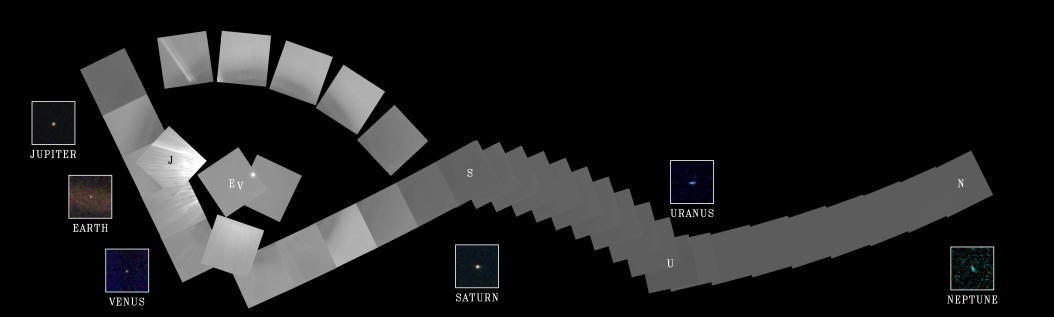
Quando a sonda Voyager 1 saía do Sistema Solar, Carl Sagan conseguiu convencer a NASA a enviar instruções ao seu longínquo emissário, para que tirasse uma série de fotos que apresentassem uma vista panorâmica do nosso Sistema Solar.

O resultado está aqui em baixo:


Clique para aumentar.

A Terra, o nosso pequeno planeta, não é mais que um ponto azul pálido nesta panorâmica. Pode ser vista nesta foto:


Com estas imagens, Carl Sagan proferiu este mini-discurso em 11 de Maio de 1996, poucos meses antes da sua morte:

(NOTA: As palavras do vídeo são ligeiramente diferentes das palavras do discurso. Mas não é o detalhe que interessa...)

We succeeded in taking that picture [from deep space], and, if you look at it, you see a dot. That's here. That's home. That's us. On it, everyone you ever heard of, every human being who ever lived, lived out their lives. The aggregate of all our joys and sufferings, thousands of confident religions, ideologies and economic doctrines, every hunter and forager, every hero and coward, every creator and destroyer of civilizations, every king and peasant, every young couple in love, every hopeful child, every mother and father, every inventor and explorer, every teacher of morals, every corrupt politician, every superstar, every supreme leader, every saint and sinner in the history of our species, lived there on a mote of dust, suspended in a sunbeam.

The earth is a very small stage in a vast cosmic arena. Think of the rivers of blood spilled by all those generals and emperors so that in glory and in triumph they could become the momentary masters of a fraction of a dot. Think of the endless cruelties visited by the inhabitants of one corner of the dot on scarcely distinguishable inhabitants of some other corner of the dot. How frequent their misunderstandings, how eager they are to kill one another, how fervent their hatreds. Our posturings, our imagined self-importance, the delusion that we have some privileged position in the universe, are challenged by this point of pale light.

Our planet is a lonely speck in the great enveloping cosmic dark. In our obscurity -- in all this vastness -- there is no hint that help will come from elsewhere to save us from ourselves. It is up to us. It's been said that astronomy is a humbling, and I might add, a character-building experience. To my mind, there is perhaps no better demonstration of the folly of human conceits than this distant image of our tiny world. To me, it underscores our responsibility to deal more kindly and compassionately with one another and to preserve and cherish that pale blue dot, the only home we've ever known.

Palavras essenciais para todos aqueles que acham que a sua vida é muito mais importante que seja o que fôr.

Fonte: Reflections on a mote of dust

domingo, 22 de abril de 2007

Como pensávamos que seria o Space Shuttle há 30 anos!

Ando a ler um livro acerca do desastre do Challenger, em 1986 - The Challenger Launch Decision: Risky Technology, Culture and Deviance at NASA - e estou numa parte em que se analisa o impacto das decisões que foram tomadas no início do programa Space Shuttle no acidente que ocorreria mais tarde. E fala lá das promessas que, na altura, pareciam douradas mas realizáveis, de até 60 missões por ano! Porque não? Afinal era uma tecnologia completamente inovadora, e reutilizável.

E lembrei-me do primeiro artigo que li acerca do Space Shuttle, nas Selecções... Sim, nessas Selecções. Foi na edição de Agosto de 1977, e eu tinha uns tenrinhos 11 anos!

Fica aqui o artigo para recordar e sorrir um pouco :)


terça-feira, 20 de março de 2007

Como em 1969 pensávamos que seria o futuro da exploração espacial!

Este artigo foi publicado na revista TIME de 25 de Julho de 1969 - na semana em que os homens andaram, pela primeira vez, na Lua. O artigo terá portanto sido escrito pouco antes desse evento histórico.

É curioso, quase humorístico, ver qual parecia ser o rumo natural das coisas, e que apenas não foi porque não enriqueceu ainda mais as grandes fortunas... Sim, como Von Braun afirmou, podíamos estar em Marte em 1982... A estação espacial podia ter estado em órbita nos anos 70, e não apenas agora...

Podia até ter havido 10 missões à Lua, em vez de apenas 6 - 7 se contarmos com a Apollo 13...

Tudo é política e dinheiro. O desejo de conhecimento não é ainda a força motivadora da Humanidade, e enquanto não o fôr, continuamos condenados, como quaisquer animais irracionais, incapazes de dominar as suas circunstâncias.

Como os dinossauros...


Friday, Jul. 25, 1969
NEXT, MARS AND BEYOND

EVEN as man prepared to take his first tentative extraterrestrial steps, other celestial adventures beckoned him. The shape and scope of the post-Apollo manned space program remained hazy, and a great deal depends on the safe and successful outcome of Apollo 11. But well before the moon flight was launched, NASA was casting eyes on targets far beyond the moon. The most inviting: the earth's close, and probably most hospitable, planetary neighbor. Given the same energy and dedication that took them to the moon, says Wernher von Braun, Americans could land on Mars as early as 1982.

Mustering the necessary zeal—not to mention the political and budgetary support—may be more difficult than mastering the technology. NASA has no plans yet for any manned expeditions beyond the moon, largely because of its inability to wrest more funds from a Congress whose members are already divided over the $24 billion tab for Apollo. Last week, as head of a task force on future U.S. space objectives, Vice President Spiro Agnew said the nation should aim for a manned Martian landing by the end of the century. But Agnew conceded that the other members of the panel might be more cautious about a manned Martian expedition.

With sufficient funds, NASA intends to launch nine more Apollo flights to the moon in the next three years. Lofted by the same powerful Saturn 5 boosters that have been Apollo's workhorses, U.S. astronauts will range over increasingly rugged areas. The scheduled Apollo 12 flight in November will take them to the Ocean of Storms. On subsequent missions, they will touch down near the Crater Censorinus, the Sea of Serenity, the Crater Tycho and finally such forbidding abysses as the craters Aristarchus and Copernicus.

As the lunar expeditions become more ambitious, so will their hardware. NASA is now improving the life-support systems in the lunar module to allow visits to the moon of up to three days by 1970. The agency is also developing more flexible space suits and designing a small rocket-propelled "lunar flyer."

NASA also hopes to keep its manned space effort alive by using surplus Saturn 4B rockets—which now serve as the third stage of the Apollo launch vehicle—for earth-orbiting flights. This effort, dubbed the Apollo Applications Program, will begin in 1971 with a 28-day flight by three men—one a doctor. These vehicles are only forerunners of a giant space station that NASA plans to orbit by the late 1970s. The first station will probably accommodate twelve people, including the first American spacewoman. It will remain aloft for at least ten years, with crew members rotated every six months.

Mapping the Red Planet

At the same time, NASA will attempt increasingly complex unmanned probes. Two unmanned Mariner spacecraft will soon pass within 2,000 miles of Mars and radio back enough close-up photographs to map about 20% of the Martian surface. In 1973, other Martian orbiters will eject two instrument-packed capsules for soft landings on Mars.

Mars, however, is only one of NASA's planetary targets—and a relatively close one at that. In 1972, the space agency will send two Pioneer spacecraft on a flyby of Jupiter, largest planet in the solar system. A year later, another Mariner will try the first multiple-planet probe. After a sweep of Venus, it will use the Venusian gravity to boost itself on toward Mercury, the sun's closest and smallest satellite. In the late 1970s, the so-called "outer planets" will be so favorably aligned that a spacecraft passing Jupiter could use its gravity to push on toward Saturn, Uranus and Neptune —a "grand tour" that would cover billions of miles and take as long as ten years.

The prospects for man's first leap into the solar system will surely be enhanced by the success of such unmanned missions. Not only will they prove the feasibility of interplanetary travel, but they will help arouse the public support necessary for such journeys. To be sure, Americans will continue to agonize over the cost of the program —which NASA says will come to no more than .5% to 1% of the gross national product (currently running at $900 billion) a year. And the question of priorities will remain relevant as long as such earthly imperfections as poverty and pollution persist. Still, as Science-Fiction Writer Isaac Asimov says, "Man has always had the other side of the hill to worry about"—and he always will. This week the other side of the hill is the moon. Before this century ends, it will almost certainly be Mars —and beyond.

Fonte: Revista Time

KSC