Mostrar mensagens com a etiqueta Mars Exploration Rovers. Mostrar todas as mensagens

quarta-feira, 26 de março de 2008

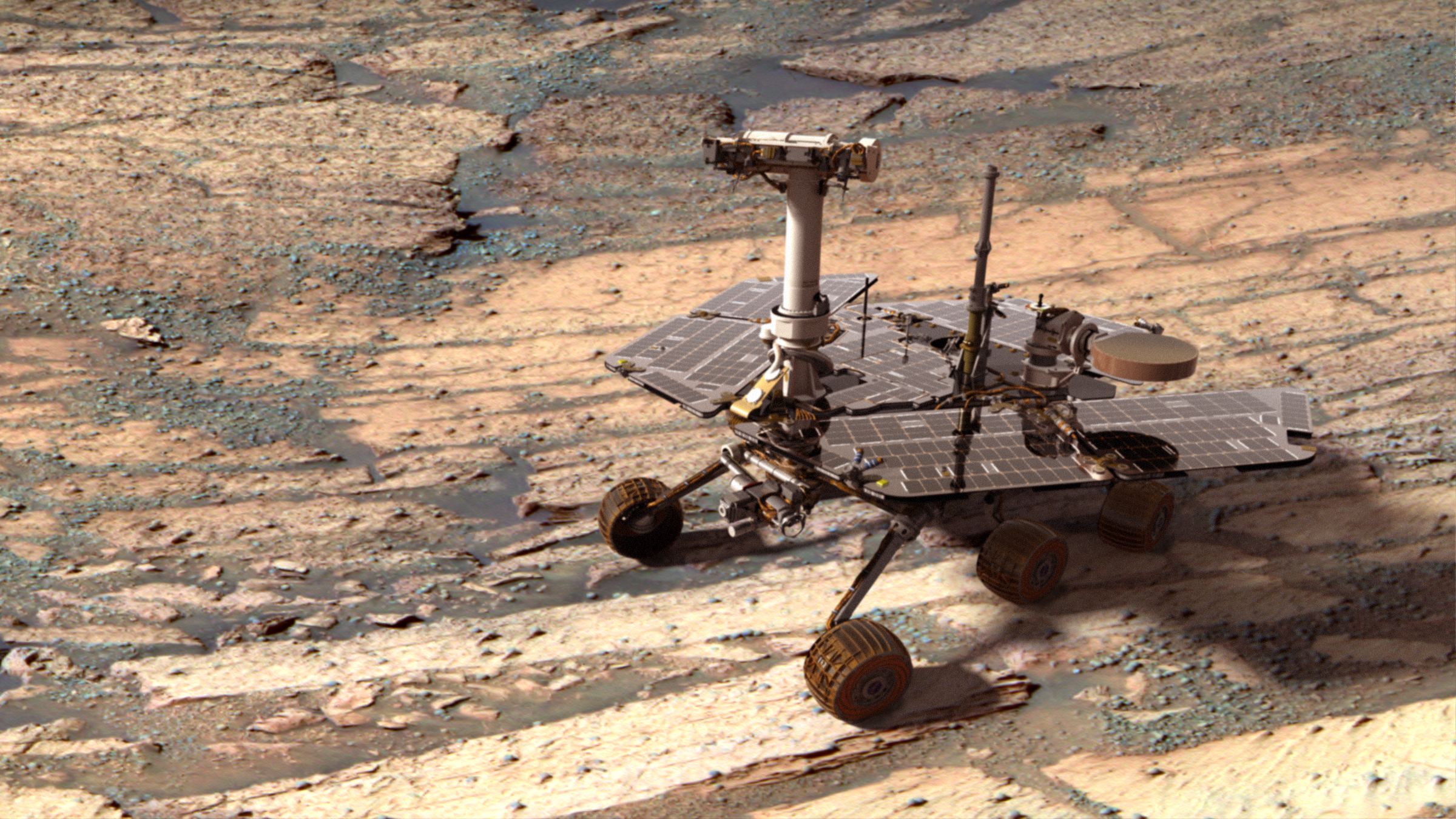
Um dos Rovers em Marte poderá ser desactivado!

Um dos Rovers da NASA em Marte poderá vir a ser desactivado, devido a um corte orçamental de 4 milhões de dólares. O responsável do projecto, Steve Squyres, propôs desactivar o rover 'Spirit', possivelmente por ser o que neste momento está em pior estado, para ajudar a fazer frente a este corte. No entanto o administrador da NASA, Michael Griffin, afirmou que para desactivar uma nave espacial há que seguir um procedimento determinado, o que não foi feito para o caso da MER Spirit, como tal essa desactivação está fora de questão. O grupo responsável pela exploração dos rovers Spirit e Opportunity teria assim de lidar com o corte orçamental de outra forma. Estão também previstos despedimentos e realocações de pessoal para outros departamentos do Jet Propulsion Laboratory (JPL).

Faço votos para que não desactivem NADA que esteja no espaço a devolver resultados úteis. Custou muito dinheiro colocar os rovers em Marte, e não se sabe quando se poderá voltar a ter algo com tanto sucesso lá! Há que aproveitar o máximo possível que estas máquinas produzam, enquanto 'forem vivas'!

Fonte: CNN

Link de interesse: NASAWatch - apresenta um ponto de vista interessante em como o JPL poderá estar a usar o 'Spirit' para fins políticos, em vez de assumir a responsabilidade pelo 'buraco financeiro' que deu origem ao corte orçamental.


Mixed signals from NASA about fate of Mars rover
From Kate Tobin

(CNN) -- NASA sent conflicting signals Monday evening about what an official told CNN is a planned $4 million budget cut in NASA's Mars Exploration Rover program.

Initially the Rover program's principle investigator, Steve Squyres, said one of two vehicles operating on the planet will be suspended because of the cut. He said he learned he would have to trim $4 million from the program's $20 million budget.

He said the move would probably force the rover Spirit into hibernation.

But, he said, the rover could be reactivated if funding is later restored. Squyres also said the cuts would mean layoffs among a staff of 300 scientists who operate and analyze the rovers.

But shortly after CNN.com published the story, NASA administrator Michael Griffin said the agency will not shut down one of the two Mars rovers, according to spokesman Bob Jacobs.

"There is a process that has to be followed for any mission to be canceled and the cancellation of the Mars Exploration Rovers is not under consideration," Jacobs said. "There is an ongoing budget review within the agency's Mars exploration program. However, shutting down of one of the rovers is not an option."

NASAheadquarters spokesman Dwayne Brown confirmed the budget directive had been issued. The cut's purpose is to offset cost overruns with the Mars Science Laboratory, a rover set to launch next year, he said.

Spirit was designed, along with its twin, Opportunity, to be a robotic geologist. The rovers have examined Martian rocks and soil, looking for telltale signs of water.

Opportunity hit pay dirt when it found evidence that salty sea once stood in the area now called Meridiani Planum.

NASA spent $800 million to build and launch Spirit and Opportunity to Mars. They landed about three weeks apart in January 2004, on opposite sides of the planet. Both were designed for 90-day missions but are still operating more than four years later.

Squyres also said he has been told to expect an $8 million budget cut in fiscal year 2009.

segunda-feira, 23 de julho de 2007

Futuro dos rovers Spirit e Opportunity em grave risco devido à tempestade global em Marte


A tempestade global de areia em Marte (de que já aqui falei) continua a piorar, e a NASA está a ponderar a possibilidade agora bem real de vir a perder um ou ambos os rovers Spirit e Opportunity.

Esta imagem compara a distribuição do pó na atmosfera de Marte
antes da tempestade (22 de Junho) e agora, durante a tempestade.

Os rovers tinham previstas missões que não iam além dos 90 dias. No entanto já estão a funcionar em Marte há mais de 3 anos! Mas o fim pode estar próximo, já que estes robots dependem da luz solar para carregar as suas baterias, e também para os manter quentes - muitos dos circuitos electrónicos dos rovers não podem ser expostos a temperaturas excessivamente baixas.

Esta tempestade é tão intensa que apenas chega à superfície 1% da radiação solar!

Esta sequência de imagens foi captada a partir do rover Opportunity, entre
14 de Junho e 19 de Julho de 2007. Os números no topo representam a
opacidade da atmosfera.

Mars rovers struggle to weather dust storm
3:05 PM, 7/22/07,

NASA's twin Mars rovers are struggling to weather widespread dust storms that have reduced solar power generation to critically low levels. If conditions worsen, one or both robots could succumb to frigid temperatures and "bite the dust" after three-and-a-half years of unprecedented exploration.

"The team is concerned. We all have very strong bond with these two rovers," said John Callas, rover project manager at the Jet Propulsion Laboratory in Pasadena, Calif. "We think of them as our children and we're worried for them right now because they're in this dangerous environmental condition on Mars.

"We're trying to help them as much as we can, but there's only so much we can do from the ground," he said by telephone Friday. "Ultimately it comes down to that. But these things are such intrepid, feisty vehicles. So the mood is 'guarded optimism.' We're watching the weather every day."

The dust storms flared up over the past month just as engineers were preparing to order Opportunity into Victoria Crater to study exposed bedrock that might hold valuable clues about the role of water on the red planet in the distant past.

Instead, the rover remains parked outside the crater, its electronic systems shut own to conserve power under a deeply overcast sky. Half a world away, the Spirit rover was in much the same state, although slightly more power positive than Opportunity.

"The figure of merit on the weather that we track is atmospheric opacity," Callas said. "The higher that number is (known by the Greek letter tau), the more sunlight is lost. Our last estimates of tau for Opportunity was around 5, which means that less than 1 percent of the direct sunlight is getting through the atmosphere. That means that basically the solar array energy is coming from the diffuse sunlight. So it's like a very overcast day and all you have is diffuse light.

"The tau for Spirit is right now at about 4, so it's not as high but it's still exceedingly high. And these numbers are higher than any numbers ever measured by Viking. The highest number Viking measured was about 4. Mariner 9, when it arrived at (Mars) the entire planet was covered with a massive global dust storm that obscured the surface. This is not quite at that scale, but this is probably the worst we've seen in, I don't know, over a decade, I guess."

Spirit and Opportunity landed on opposite sides of Mars three weeks apart in January 2004. They were designed to operate for at least 90 days and while hopes were high they would survive the harsh martian environment beyond their design life, no one expected them to last as long as they have. As of last week, Opportunity had logged some 1,240 days on Mars and the rovers are considered among the most successful interplanetary missions ever launched.

At present, the ongoing martian dust storm is best described as "hemispheric." It doesn't shroud the entire planet but Spirit and Opportunity, on opposite sides of Mars, are both affected.

"A possible outcome of this storm is that one or both rovers could be damaged permanently or even disabled," NASA said in a statement Friday. "Engineers will assess the capability of each rover after the storm clears."

The forecast, Callas said, is "not good. More of the same."

"And it's been variable. We've been spoofed a couple of times where the tau would spike up and then it would turn around and drop down a little bit and we'd think oh, well the worst is past. And then it would just turn around again and spike back up to a new record."

Conditions are slightly worse over Opportunity. Solar panel output stood at around 720 watt hours of electricity before the dust storm began. Seven hundred watt hours is enough electricity to power a 100-watt bulb for seven hours.

When the solar panel output dropped below 400 watt hours a day, Opportunity was parked and its science observations terminated. On July 17, power output dropped to 148 watt hours and one day later, to 128 watt hours, barely enough for the heaters needed to keep the electronics warm enough to prevent problems.

"What we've had to do is pretty much take everything out of the sequence the rover normally does," Callas said. "So it just wakes up and goes back to sleep after being up for a short amount of time. We do have communications sessions, but right now we're sprinkling them about every three days."

Flight controllers sent commands to Opportunity Friday but did not plan to check in again until Monday.

Callas said the electronics in each rover is mounted inside an insulated box and that is thermostatically protected. The avionics system is designed to operate at temperatures as low as minus 40 degrees Fahrenheit and to survive, powered down, at temperatures as low as minus 67 degrees. Below that, the rover would be at risk of failures from cracked wires or damage to other components.

So far, ground temperatures near Opportunity are running at around minus 26 degrees. And even if one or both orbiters ultimately had to be powered down and temperatures dropped below allowable limits, "it would not be certain death," Callas said. "There's some expectation that if we got outside of our operating regimes that the hardware would hang together."

When the sky eventually clears, "the rover would power back up, it would wake up on its own and it would boot up and it would start phoning home."

Callas said as long as the rovers remain power positive - generating more electricity than they consume - "we could ride this out forever."

"But if it gets just a little bit worse, then that could tip us over the edge and then we'd start running negative," he said. "What you do is, you're taking more energy out of the batteries each day than you're putting back in."

Eventually, the batteries would be drained and no power would be available for the heaters. Engineers are hopeful it won't come to that.

quinta-feira, 5 de julho de 2007

Enorme tempestade em Marte está a dificultar as operações dos Rovers Spirit e Opportunity.

Neste momento a tempestade de pó é apenas regional, e localizada perto do local de operações da Spirit. Esta está do lado oposto de Marte em relação à Opportunity, que tinha pleaneada uma descida à cratera Victoria para os próximos dias.

Essa descida está agora adiada por tempo indeterminado, uma vez que uma acumulação de pó nos painéis solares dos rovers lhes irá diminuir muito a capacidade de gerar electricidade.
Embora a tempestade seja, neste momento, apenas regional, por vezes estas tempestades desenvolvem-se até abarcar o planeta inteiro (!), e podem durar meses!

Fonte: MSNBC

Link: Space.com


Mars rovers lose power amid dust storm
Dark skies affect solar arrays; descent into crater delayed, NASA says
By Robert Roy Britt
Senior science writer
Space.com
Updated: 3:43 p.m. ET July 4, 2007

A major dust storm on Mars has worsened and is causing the Mars Exploration Rovers to lose power.

Opportunity's highly anticipated and risky entry into Victoria Crater is delayed for at least several days, NASA announced.

The regional storm, first reported by Space.com, is the most severe to hit the rovers since they began exploring Mars in January 2004. Already last week it was thousands of miles wide. At first, scientists did not expect it to affect rover operations.

But dust from the storm is partly blocking sunlight, which the rovers need in order to recharge their batteries via their solar panels. Opportunity's operations were scaled back June 30 to conserve power, according to the statement.

"The storm is affecting both rovers and reducing the power levels on Opportunity," said John Callas, Mars Exploration Rover project manager at NASA's Jet Propulsion Laboratory. "We are keeping an eye on this as we go forward, but our entry into Victoria Crater will be delayed until no sooner than July 13."

The storm is expected to continue for at least another week. In the past, regional tempests have been known to grow and engulf the entire planet.

"We have some data that show the atmospheric opacity is decreasing, so the storm might have peaked and we may have passed the worst of this," Callas said. "The situation could improve quickly from here, but we will have to wait and see."

Opportunity is perched near Duck Bay at the rim of Victoria Crater on Meridiani Planum.

Pictures from NASA's Mars Reconnaissance Orbiter show the storm is regional and includes several local areas of especially high dust activity. The images were not released. The storm has been moving eastward and toward midlatitudes and is now also kicking up more dust at Spirit's location, on the opposite side of the planet at Gusev Crater.

The rovers measure atmospheric dust daily, and Opportunity revealed a new record, with the air's "opacity level" rising from 1.0 to 3.3. Solar array energy on the rover dropped from 765 watt-hours to 402. Dust levels at Spirit's location were much lower.

"While this only represents enough dust to coat the planet to about the thickness of a human hair, it is enough to decrease the brightness of the noon sun by 96 percent compared to a completely clear atmosphere," said Steve Squyres, a Cornell University researcher who is principal investigator of the rover mission. "The solar arrays also receive light that is scattered from the dust, so the decrease in power is not nearly that great."

"We have not seen dust measurements this high on either rover before," Callas said. "If the dust levels were to increase further and stay elevated for several days, there is a risk to how well Opportunity could continue to work in this darkened environment."

sexta-feira, 8 de junho de 2007

Mais notícias fantásticas de Marte: POÇAS de água!!!

Esta nova notícia não pode, naturalmente, ainda ser confirmada a 100%.

A possibilidade da existência de poças de água em Marte surgiu da análise de fotos tiradas há dois anos, quando o rover Opportunity explorava a cratera 'Endurance'. Fotos tiradas aos rastos do rover tinham um leve reflexo azul, que foi intensificado na imagem da direita.

Naturalmente, pode ser outra coisa qualquer, mas a ser água, a possibilidade da existência de vida em Marte sobe exponencialmente!

Fonte: New Scientist Space


Mars rover finds "puddles" on the planet's surface

* 15:33 08 June 2007
* NewScientist.com news service
* David Chandler

Smooth bluish areas on a Martian crater floor could be ponds, according to two scientists. The area is approximately 1 square metre (Image: Ron Levin)

A new analysis of pictures taken by the exploration rover Opportunity reveals what appear to be small ponds of liquid water on the surface of Mars.

The report identifies specific spots that appear to have contained liquid water two years ago, when Opportunity was exploring a crater called Endurance. It is a highly controversial claim, as many scientists believe that liquid water cannot exist on the surface of Mars today because of the planet’s thin atmosphere.

If confirmed, the existence of such ponds would significantly boost the odds that living organisms could survive on or near the surface of Mars, says physicist Ron Levin, the report's lead author, who works in advanced image processing at the aerospace company Lockheed Martin in Arizona.

Along with fellow Lockheed engineer Daniel Lyddy, Levin used images from the Jet Propulsion Laboratory's website. The resulting stereoscopic reconstructions, made from paired images from the Opportunity rover's twin cameras, show bluish features that look perfectly flat. The surfaces are so smooth that the computer could not find any surface details within those areas to match up between the two images.

The imaging shows that the areas occupy the lowest parts of the terrain. They also appear transparent: some features, which Levin says may be submerged rocks or pebbles, can be seen below the plane of the smooth surface.

Smooth surface

The smoothness and transparency of the features could suggest either water or very clear ice, Levin says.

"The surface is incredibly smooth, and the edges are in a plane and all at the same altitude," he says. "If they were ice or some other material, they'd show wear and tear over the surface, there would be rubble or sand or something."

His report was presented at a conference of the Institute of Electrical and Electronics Engineers, and will be published later this year in the institute's proceedings.

No signs of liquid water have been observed directly from cameras on the surface before. Reports last year pointed to the existence of gullies on crater walls where water appears to have flowed in the last few years, as shown in images taken from orbit, but those are short-lived flows, which are thought to have frozen over almost immediately.

Speedy evaporation?

Levin and other reasearchers, including JPL's Michael Hecht, have published calculations showing the possibility of "micro-environments" where water could linger, but the idea remains controversial.

“The temperatures get plenty warm enough, but the Mars atmosphere is essentially a vacuum," says Phil Christensen of Arizona State University, developer of the Mars rovers' mini-Thermal Emission Spectrometers. That means any water or ice exposed on the surface evaporates or sublimes away almost instantly, he says.

But, he adds, "it is theoretically possible to get liquid water within soil, or under other very special conditions". The question is just how special those conditions need to be, and whether they ever really are found on Mars today.

If there were absolutely no wind, says Christensen, you might build up a stagnant layer of vapour above a liquid surface, preventing it from evaporating too fast. “The problem is, there are winds on Mars… In the real world, I think it's virtually impossible," he told New Scientist.

Simple test

Levin disagrees. He says his analysis shows that there can be wind-free environments at certain times of day in certain protected locations. He thinks that could apply to these small depressions inside the sheltered bowl of Endurance crater, at midday in the Martian summer.

He adds that highly briny water, as is probably found on Mars, could be stable even at much lower temperatures.

Although the rover is now miles away from this site, Levin proposes a simple test that would prove the presence of liquid if similar features are found: use the rover's drill on the surface of the flat area. If it is ice, or any solid material, the drill will leave unmistakable markings, but if it is liquid there should be no trace of the drill's activity.

Levin’s father Gilbert was principal investigator of an experiment on the Viking Mars lander, which found evidence for life on the planet, although negative results from a separate test for organic materials led most scientists to doubt the evidence for biology.

Journal reference: R. L. Levin and Daniel Lyddy, Investigation of possible liquid water ponds on the Martian surface (2007 IEEE Aerospace Applications Conference Proceedings, paper #1376, to be published in IEEE Xplore)

sábado, 17 de março de 2007

Inverno em Marte - um panorama fantástico!

Durante o Inverno Marciano, o Rover Spirit, da NASA, esteve parado numa posição que lhe permitia receber a maior quantidade possível de radiação solar, o que lhe permitia manter as baterias minimamente carregadas e, talvez, sobreviver mais um ano na superfície do planeta.

No entanto não esteve completamente inactivo. Durante esses meses tirou uma série de fotografias (cerca de 1400), que foram combinadas em mais um panorama fantástico de um planeta que ainda nos é desconhecido... mas que de certa forma nos parece familiar.

Uma empresa alemã criou um panorama em QTVR (QuickTime Virtual Reality) que nos permite olhar para a esquerda, para a direita, para cima e para baixo, e zoomar, quase como se lá estivéssemos.

Adorava que estas tecnologias existissem quando tinha 15 anos. Nunca ia largar o PC. Mesmo hoje ainda sou capaz de ficar imenso tempo a imaginar que estou lá... É fácil com estas tecnologias!

Fico infeliz por saber que há tanta gente que não consegue compreender até que ponto é fantástico obter imagens destas a tantos milhares de quilómetros de distância. Sim, são só pedras.

Mas estão em Marte!

Links:

KSC